June 3, 2004
By Crayton Harrison/ The Dallas Morning News
Ron
Kaplan thanked members of an Internet message board in the liner notes of his band's new album. Without them, the Dallas
drummer would have had trouble putting out a record with bandmates who live 1,000 miles away.
Mr. Kaplan has been a drummer for most of his life, but it was only three years
ago that he began turning into a technology buff. An old friend in Chicago, Dick Eastman, wanted him to lay down some drum
tracks for a new record by his band, the Cleavers.
At
first, the musicians planned for Mr. Kaplan to make several trips to Chicago to record the material. But the Sept. 11 attacks
convinced Mr. Kaplan that it would be safer to avoid flying. The Cleavers would have to find another way to assemble the songs.
That challenge turned Mr. Kaplan into a self-taught,
computer-savvy recording engineer, something he never thought he'd be. "I had recorded in professional studios before,
but always on the other side of the glass," he said. "I never paid much attention to them as they were working the
dials."
Mr. Kaplan grew up in Chicago and played
in area bands from his teens through his mid-30s, when he moved to Dallas to work for a promotional products distributor.
His biggest taste of fame came when he joined the Cryan' Shames, a popular Midwestern act, for a short stint when he was
18. Mr. Eastman was a staff songwriter for MCA Music in the mid-1980s. The two had played together in a band in 1979 and remained
friends.
When Mr. Eastman asked Mr. Kaplan to join
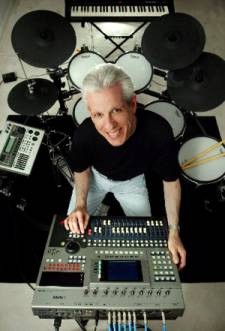
his project, Mr. Kaplan went out to buy his first electronic drum kit, a Roland V-Session similar to one Mr. Eastman was using.
Then he bought the Yamaha AW4416 Digital Audio Workstation, a 16-track recorder and mixing board, also akin to one Mr. Eastman
owned.
The Yamaha workstation, which the company
has since updated and modified, allows musicians to produce master CDs of their recordings. Other Yamaha soundboards can read
the CDs, so the musicians sent recordings back and forth, mixing in their ideas penpal-style.
They also used Apple Computer Inc.'s iTunes software to rip the music off their
master CDs into MP3 form, allowing them to quickly send digital copies of their music to each other for instant feedback.Mr.
Kaplan mixed all the drum tracks, and the rest of the band mixed the other tracks. "It took us awhile to get a good working
routine back and forth," Mr. Kaplan said. "Not only was I trying to learn the songs, I was trying to learn to work
the equipment."
Mr. Kaplan found help in one
of the Internet's esoteric little corners, a Yahoo message board that focuses specifically on the Yamaha AW4416. Gathered
there were experts from as far away as Australia providing free recording advice and innovative techniques. "You get
quite a recording education," Mr. Kaplan said. "You could never pay anybody enough to learn all of this."
Mr. Kaplan knows that some technologically sophisticated musicians
are using even more advanced software and computerized instruments to make their music quickly and inexpensively, and he wants
to learn more. But he has a new electronic drum kit — a Roland TD-20 — to master first. "There's nothing
I'd like better than a new laptop, but I'm familiar playing drums," he said. "I thought I'd start with
this and see how it goes."
The Cleavers are
hosting streaming audio samples of their finished disc, Television Mind, at www.allrightrecords.com.